whoa:
http://cyborganthropology.com/Main_Page
Wednesday, January 5, 2011

Tuesday, January 4, 2011
stars, cigarettes, radio phantoms, runaway urges
Perhaps he consumed too much coffee that day. His body was soaked in fear and cigarettes. The woman's voice on the radio was seductive and foreboding. She sounded like a preacher, but there was no god in what she said, except for her subtle forecast of the end.
He turned the radio off after ten minutes, thinking that if he listened to everything the woman said he would somehow curse himself with her evil words.
Why do so many people talk about apocalypse these days? Surely, there were equally barbaric times before this.... but perhaps they weren't so mechanized....
He thought to himself.
Music. Music will fix the problem.
The record of French pop music from the 1960s was worn from overuse. Post-punk refused to make him happy.
Debussy?
No.
Hmmm...
Little could.
He was restless, and the sky was dark outside. His sleepy town was sleeping. Since childhood, he fantasized about running away, always, for no explicit reason except for the experience of flight. He had an addiction to movement. The cigarettes gave him excuses. He always needed excuses to go outside and watch the clouds or the stars. He always needed excuses to give himself time.
If I ran away right now, where would I go, and would it matter? If I stopped, I would only want to start again. I can't stop. Ever.
As a child, he used to be afraid of the night sky. Its infinity terrified him. These days, he would sit outside for hours in the cold and let himself be drawn in by the tides of ancient stars. It was one of his few consolations. It gave him odd comfort and a feeling of grace. It was one of the only meaningful things he could consistently observe.
On the rare occasions when he would sleep and remember his dreams, he would dream of long lost lovers and alternative realities. In daylight, he drew out the experience of standing at crossroads presumably for the thrill of conflict and uncertainty. He never enjoyed responsibility.
His education told him that he could do anything he wanted to, and he hated his teachers for making him believe. The possibilities paralyzed him into boredom and forced apathy. He wasn't sure whether his love of whiskey was his savior or his end.
After pacing around his living room for a full 20 minutes, trying to decide if he should take a late night drive, he turned the radio on again. The woman's voice was gone. Jazz. He withered into his most-worn chair and wept.
I'd like to have a home and a purpose and some peace of mind.

He turned the radio off after ten minutes, thinking that if he listened to everything the woman said he would somehow curse himself with her evil words.
Why do so many people talk about apocalypse these days? Surely, there were equally barbaric times before this.... but perhaps they weren't so mechanized....
He thought to himself.
Music. Music will fix the problem.
The record of French pop music from the 1960s was worn from overuse. Post-punk refused to make him happy.
Debussy?
No.
Hmmm...
Little could.
He was restless, and the sky was dark outside. His sleepy town was sleeping. Since childhood, he fantasized about running away, always, for no explicit reason except for the experience of flight. He had an addiction to movement. The cigarettes gave him excuses. He always needed excuses to go outside and watch the clouds or the stars. He always needed excuses to give himself time.
If I ran away right now, where would I go, and would it matter? If I stopped, I would only want to start again. I can't stop. Ever.
As a child, he used to be afraid of the night sky. Its infinity terrified him. These days, he would sit outside for hours in the cold and let himself be drawn in by the tides of ancient stars. It was one of his few consolations. It gave him odd comfort and a feeling of grace. It was one of the only meaningful things he could consistently observe.
On the rare occasions when he would sleep and remember his dreams, he would dream of long lost lovers and alternative realities. In daylight, he drew out the experience of standing at crossroads presumably for the thrill of conflict and uncertainty. He never enjoyed responsibility.
His education told him that he could do anything he wanted to, and he hated his teachers for making him believe. The possibilities paralyzed him into boredom and forced apathy. He wasn't sure whether his love of whiskey was his savior or his end.
After pacing around his living room for a full 20 minutes, trying to decide if he should take a late night drive, he turned the radio on again. The woman's voice was gone. Jazz. He withered into his most-worn chair and wept.
I'd like to have a home and a purpose and some peace of mind.

Monday, January 3, 2011
for auld lang syne

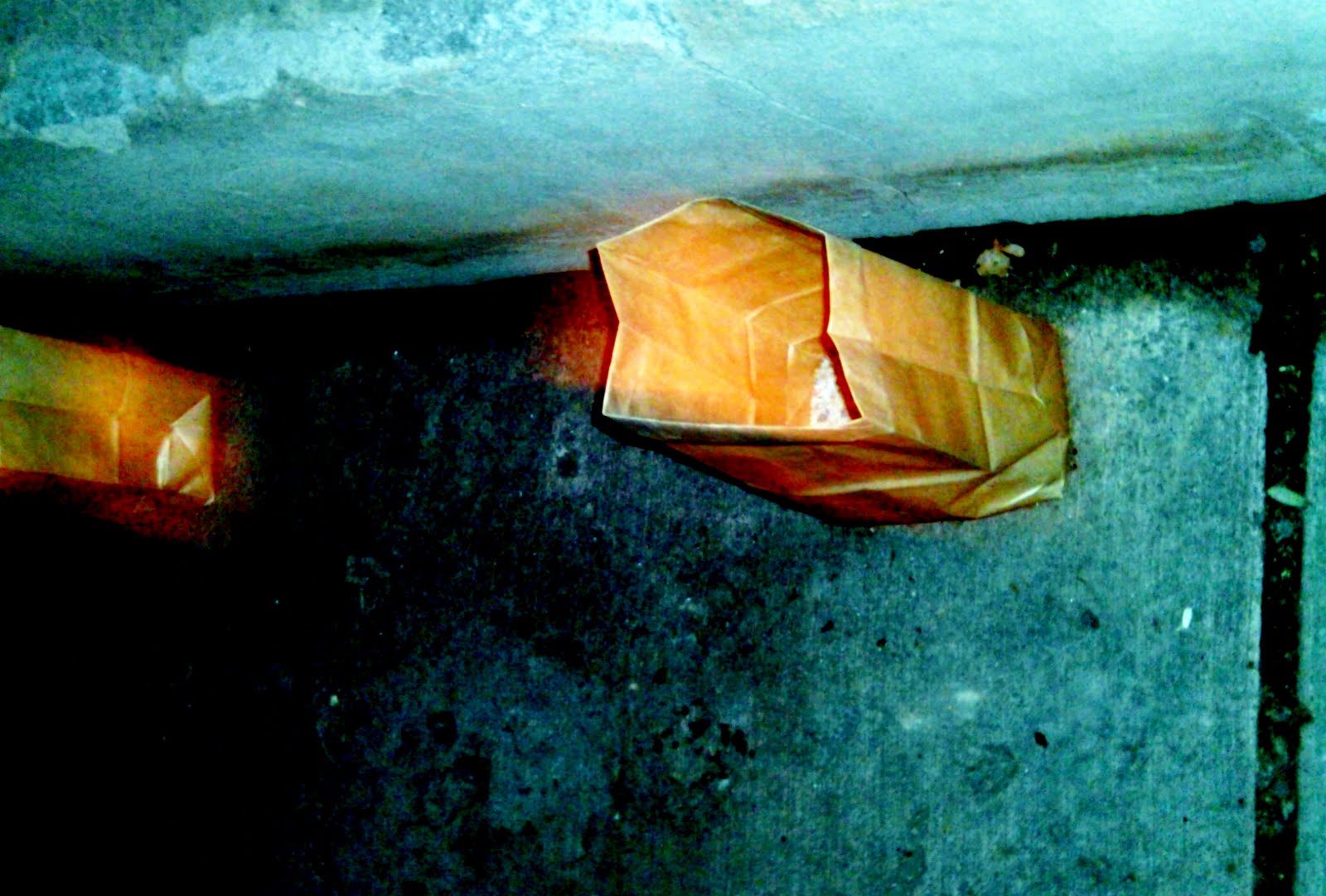
so it's a new year. It feels good and I feel good. I spent my first Christmas and New Years in Santa Fe this year. I discovered that Santa Fe's Christmas Eve Farolito Walk is probably its most lovely well-known tradition.
I could share some photos of the Farolito Walk, and possibly even a video of songs by the bonfire-side, but I feel like my blog is a little too conventional. I've been reading this local blog, as well as this other local blog that I am a lazy contributor to, and I feel like I need to step up my game a little and get a bit more creative with this. My diary is a hell of a lot more interesting than this blog so far, but it's certainly not for the internet-going-masses.
I think that's it actually. There's a weird self-consciousness that occurs in our interactions in the internet world. The various social networking websites that plague our increasingly cyborg-like existences turn people into their own reality TV stars, or at least get them to self-document their lives as if they were on their own personal versions of "Jersey Shore" or "The Real World." As Andy Warhol said, "in the future, everyone will be famous for fifteen minutes." The reality seems to be more like: in this great year of 2011 people will think they are famous so long as they have hoards of Facebook friends and Twitter followers and tweet every time they take a shit or get wasted at a club or watch an episode of Glenn Beck, etc. etc. etc.
But the self-consciousness I refer to is not limited to the aforementioned gradual disintegration of culture and language at the hands of instantly accessible internet applications that can broadcast and stoke human vanity with fewer and fewer written characters. No, the self-consciousness I refer to is a simple product of the high-speed context-less communication new media offers us.
When we have no audible voice, no physical presence, no visual picture, no human context of experience, no human idiosyncrasies, no emotion, and just virtually typed words-- words that are so heavy with different contexts for each special human being-- communication can become a very self-conscious act, and it can become very challenging to effectively express one's self-- it can feel unsafe to explore provocative ideas in such an inhumane medium.
Such self-consciousness can hinder an exploration of new ideas. Learning and experimentation require comfort with uncertainty and the possibility of being wrong, as Sir Ken Robinson mentions in this really phenomenal TED talk that I happened to watch on Christmas with friends:
So here's to the New Year, and all the new endeavors it will bring. Here's to more experimental internet communication. In the meantime, here is some farolito walk documentation:


Friday, December 24, 2010
indoor winter activities
the title of this post is the name of one of many fabulous shows the local artist collective Meow Wolf produced a few years ago, but it also describes what we people do at this lovely time of year.
A few of my indoor winter activities have included making my first ever gingerbread house.


I also revisited source recordings from my time in Europe this summer, and I made this video of a few highlights from the Bulgarian National Folklore festival I attended in August:
I can't wait to go back and study and perform some projects out there.
A few of my indoor winter activities have included making my first ever gingerbread house.


I also revisited source recordings from my time in Europe this summer, and I made this video of a few highlights from the Bulgarian National Folklore festival I attended in August:
Koprivshtitsa 2010 (копривщица 2010) from Alysha Shaw on Vimeo.
I can't wait to go back and study and perform some projects out there.
Sunday, December 19, 2010
current research interests
(all constantly in flux, and not entirely comprehensive)
- anonymous public performance/modified invisible theater
- the new mexico state legislature
- tarot
- macedonian/bulgarian dialects
- eastern european governance
- anarchy
- greece
- post-communism
- feminist theory in practice
- postmodern theory in practice
- utopian experiments
- permaculture
- d-i-y alternative energy (gaviotas-style)
- american history
- american folk culture
- kitsch
- global hipster culture
- world war two
- new mexican history
- atomic history
- the buckman direct diversion project
- the santa fe art world
- tourist culture
- dichotomies
- the boundaries between art and life
- pedagogy
- public private partnerships
- the st. michael's corridor
- hopewell mann
- gang culture
- folklore
- folk dancers
- "no child left behind"
- evolution of authoritarianism
- evolution of corporations
- evolution of colonialism
- cultures derived from career
- socioeconomic stratification
- evolution of new media/old media/journalism
- the effects of new media saturation (i.e. cellphones, email, facebook, t.v., internet, etc..) on human development
- middle of nowhere settlements
- meditation
- history of subversion
- history of satire
- potential subversive uses of political campaign structure and mechanisms
- balkan folk music, dance, and history
- cross-disciplinarity
- role of audience
- historical and contemporary roles of culture/art in community
- belarus
- roots/rootlessness
- globalization
- rural/urban migration
- non-linguistic communication
more... to be continued
Wednesday, December 15, 2010
zurnas and tupans and folkdancers...
...in the town square of Koprivshtitsa (копривщица), Bulgaria this past August. I am in that crowd somewhere. I've been inexplicably nostalgic and especially nerdy about Balkan music since performing that Macedonian song on Monday. It's strange. It must be a part of processing and conceiving new ideas. I think I'm trying to figure out how something as specialized and obscure as Balkan music could fit into a social art project. Of course, the broad set of music denoted by the blanket term "Balkan music" usually isn't specialized and obscure to the local people it belongs to-- my favorite music from the Balkans is mostly old, old, old folk music (although there are communist songs, Eastern classical pieces, pop and Arabesque, among others). But it all is non-Western, to say the least, and it's interesting to me that a fair number of Americans have become similarly obsessed with the music and traditions of countries as far away as Albania, Greece, Turkey, Macedonia, Ukraine, Bulgaria, Hungary, Georgia, Serbia, Romania, Mali, Egypt, Morocco, Algeria, Tuva, Indonesia, etc. etc. etc.
Tuesday, December 14, 2010
missing the aegean
Since backpacking across Europe this summer, I periodically find myself craving the isolated and anarchic places in the Balkans I was overjoyed to experience. I constantly find myself wishing I could smoke cigarettes indoors. I daydream about the Aegean water and the Greek food and the Turkish music and the Cyrillic alphabet and the people. I'm already planning new journeys in my mind, but I have no idea when I will have the liberty of taking them.
My nostalgia also makes me wonder if being a fragmented, globalized person is a nationality or an allegiance in and of itself. Can one convert to gypsy-ism? Knowing the little I do about Roma from playing some of their music, I'm pretty sure that's impossible, and somewhat naive.
So why don't I just share some photographs instead?
This was taken in the village of Koprivshtitsa, Bulgaria at a national folk music and dance festival they host once every 5 years. I'm the dancer in the orange-y red dress towards the right.

A disorganized album with a few of my photos from the Balkans can be found here:
I have an entire memory card full of source recordings from the Bulgarian folk music festival I haven't looked at in months. Whenever I upload them, I'll post a few here.
One of the most sobering aspects of my experience in Bulgaria is the fact that when the next Koprivshtitsa festival rolls around, more Bulgarian dialects and traditional music and dancing will be lost forever. An American musician we met on the train from Istanbul to Sofia put it this way, "Better get good source recordings at Koprivshtitsa, because you are going to hear music that may never be heard again. Someday there will just be the one Bulgarian dance-- the one Bulgarian folk song," which is tragic for an ancient country with incredible diversity in culture, folk art, and dialects.
The locals we met our first night in Sofia were confused about why we Americans were visiting their country. They told us, "we want to go to America-- there is nothing here." When we told them that we came to Bulgaria because of the folk music and dancing, they thought we were crazy. One woman said, "I hate that music," while bad English-language techno ironically played in the background of the club we were in. As the night progressed, the locals persuaded us to sing a Bulgarian song. We sang a three-part arrangement of a folk song called "Melai Doina." The woman who said she hated her own country's folk music started to cry. She told us, "you are more Bulgarian than we are."
And she didn't even see the Japanese Bulgarian Women's Choir perform at Koprivshtitsa.
Globalization is strange. There's infinitely more to be said about that. Throw post-communism into the mix, and it gets weirder and more depressing.
My nostalgia also makes me wonder if being a fragmented, globalized person is a nationality or an allegiance in and of itself. Can one convert to gypsy-ism? Knowing the little I do about Roma from playing some of their music, I'm pretty sure that's impossible, and somewhat naive.
So why don't I just share some photographs instead?
This was taken in the village of Koprivshtitsa, Bulgaria at a national folk music and dance festival they host once every 5 years. I'm the dancer in the orange-y red dress towards the right.

A disorganized album with a few of my photos from the Balkans can be found here:
I have an entire memory card full of source recordings from the Bulgarian folk music festival I haven't looked at in months. Whenever I upload them, I'll post a few here.
One of the most sobering aspects of my experience in Bulgaria is the fact that when the next Koprivshtitsa festival rolls around, more Bulgarian dialects and traditional music and dancing will be lost forever. An American musician we met on the train from Istanbul to Sofia put it this way, "Better get good source recordings at Koprivshtitsa, because you are going to hear music that may never be heard again. Someday there will just be the one Bulgarian dance-- the one Bulgarian folk song," which is tragic for an ancient country with incredible diversity in culture, folk art, and dialects.
The locals we met our first night in Sofia were confused about why we Americans were visiting their country. They told us, "we want to go to America-- there is nothing here." When we told them that we came to Bulgaria because of the folk music and dancing, they thought we were crazy. One woman said, "I hate that music," while bad English-language techno ironically played in the background of the club we were in. As the night progressed, the locals persuaded us to sing a Bulgarian song. We sang a three-part arrangement of a folk song called "Melai Doina." The woman who said she hated her own country's folk music started to cry. She told us, "you are more Bulgarian than we are."
And she didn't even see the Japanese Bulgarian Women's Choir perform at Koprivshtitsa.
Globalization is strange. There's infinitely more to be said about that. Throw post-communism into the mix, and it gets weirder and more depressing.
Subscribe to:
Posts (Atom)